






Foundations of Social Movement Theory

Foundations of Social Movement Theory: From Classical Paradigms to Contemporary Approaches
Efe Can Gürcan
Copyright 2025
ISBN: 978-1-9194097-0-2 (pbk)
ISBN: 978-1-9194097-1-9 (ebk)
Pages: 171
Published: December 29, 2025 by Minerva Academic
Book Series: Minerva Series in Social and Political Theory

Book Description

This book offers a rigorous intellectual roadmap to the core traditions that have shaped the modern study of collective action. It argues that understanding how ordinary people transform society requires starting from theory—not as abstraction, but as an analytic toolkit for interpreting protest, organization, and resistance. Throughout the book, theoretical debates are consistently grounded in concrete cases, ranging from climate strikes and feminist mobilizations to anti-racist uprisings, labor movements, and digital campaigns, demonstrating why strong theoretical grounding remains indispensable.

Moving in a broadly historical and genealogical arc, the book traces the field from Cold War–era collective behavior and structural-strain approaches to the breakthroughs of Resource Mobilization and Political Process theories. It then examines the cultural turn through framing and identity-based perspectives, the emergence of New Social Movements, and the synthesis attempted by the contentious politics paradigm. A final chapter turns to contemporary Marxist and critical political economy approaches, reconnecting social movement theory with questions of capitalism, empire, and global inequality.

Rather than an exhaustive survey, this volume mostly concentrates on the foundational canon—those frameworks that continue to structure how scholars ask questions, design research, and interpret movements in an age of digital activism, transnational networks, and Global South uprisings. It is an essential point of departure for students and researchers seeking a deep, conceptually grounded entry into social movement studies, while also equipping advanced scholars with a refined theoretical architecture for re-evaluating established paradigms and engaging emerging questions in the field.

About the Author

Efe Can Gürcan is a Visiting Scholar at Queen’s University Belfast as well as an Adjunct Professor at the Shanghai University and an Associate Professor at İstanbul Nişantaşı University. Additionally, he serves as the Editor-in-Chief of Global Geopolitics, an Associate Editor of the Journal of Labor and Society, and a Standing Council member of the World Association for Political Economy (WAPE). Gürcan completed his undergraduate education in International Relations at Koç University. He received his master’s degree in International Studies from the University of Montréal and earned his Ph.D. in Sociology from Simon Fraser University. Gürcan is a former Social Sciences and Humanities Research Council/Joseph-Armand Bombardier scholar (Category A). He was awarded the 2014 Albert Szymanski Award by the American Sociological Association, the 2021 Outstanding Young Scientist Award by the Turkish Academy of Sciences, and the 2023 Distinguished Achievement Award in Political Economy by the WAPE. He became a member of the Turkish Young Academy of Sciences in 2021 and joined its Executive Board in 2025. Gürcan has authored seven books and over 50 articles on international political economy, geopolitics, and political sociology.

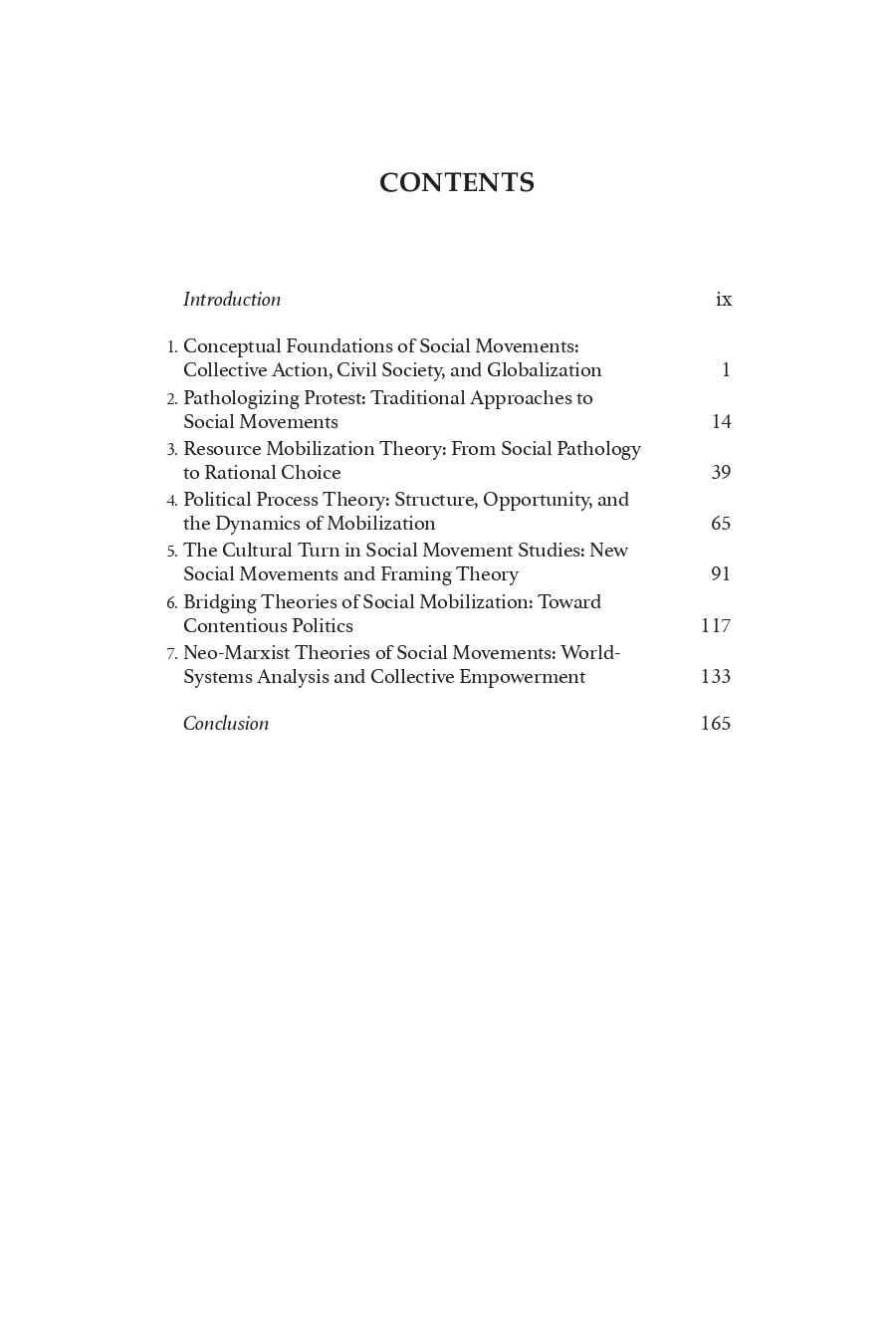
Contents

Introduction ix
1. Conceptual Foundations of Social Movements:
Collective Action, Civil Society, and Globalization 1
2. Pathologizing Protest: Traditional Approaches to
Social Movements 14
3. Resource Mobilization Theory: From Social Pathology
to Rational Choice 39
4. Political Process Theory: Structure, Opportunity, and
the Dynamics of Mobilization 65
5. The Cultural Turn in Social Movement Studies: New
Social Movements and Framing Theory 91
6. Bridging Theories of Social Mobilization: Toward
Contentious Politics 117
7. Neo-Marxist Theories of Social Movements: WorldSystems Analysis and Collective Empowerment 133
Conclusion 165